The most revealing line
in Amazon's AI memo.
Published
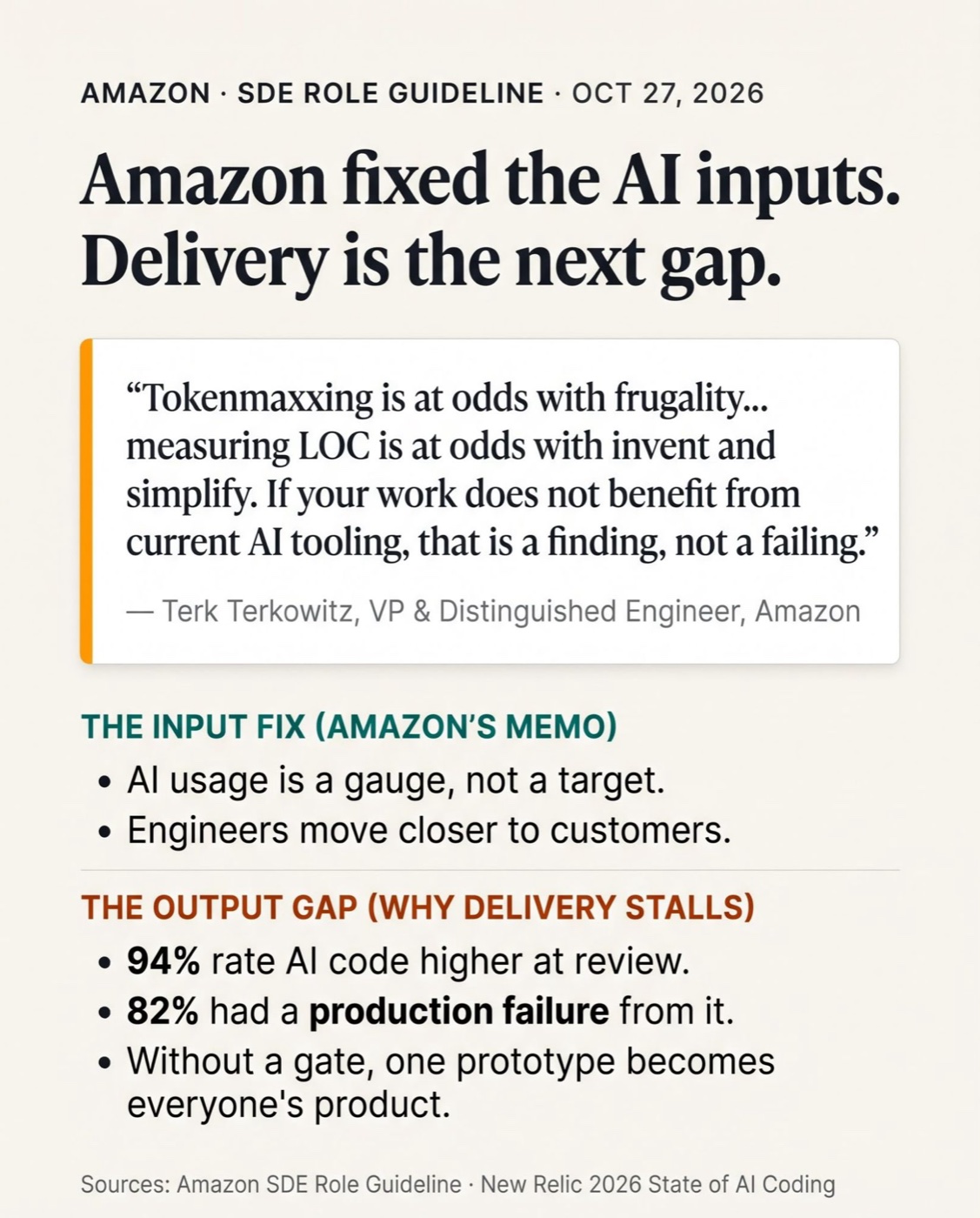
Everyone is quoting Amazon's warning against "tokenmaxxing" this week.
But the most revealing line in Amazon's new engineering memo isn't about the engineers avoiding AI.
It's about the ones using it the most.
VP & Distinguished Engineer Terk Terkowitz tells managers to inspect the 90th percentile of AI adoption—the teams burning the most tokens and generating the most code changes—and check "whether they're seeing delivery increases to match."
Why wouldn't heavy AI usage automatically translate into faster delivery?
Because AI made generating a working version cheap. It did not make reviewing, hardening, and maintaining it in production cheap.
Look at the gap in New Relic's 2026 State of AI Coding survey (200 US tech decision-makers):
- 94% say AI-generated code scores higher at initial code review.
- 82% report production failures caused by AI code in the last six months.
When you give agentic AI to teams close to the customer, they can spin up a slick prototype in days. On screen, and in the review queue, it looks cleaner than it is.
If you don't put a hard architectural fence around those experiments, one-off prototypes get quietly promoted into the shared core product. Rework compounds, releases slow down, and the R&D budget quietly fills up with custom maintenance—a dynamic buyers punish in diligence (1–2.6x revenue for services-heavy software vs. 3–3.8x for vertical SaaS, per Aventis Advisors).
Amazon is right: token use is a gauge, not a goal.
But the real bottleneck in 2026 isn't how much AI your team uses to build a prototype. It's having a clear gate—and a named technical lead—to decide whether that code gets Adopted, Refactored, or Rebuilt before it ever touches the core.
Where does your team draw the line between a fast AI prototype and production-ready code?
Sources
- Amazon memo: https://www.aboutamazon.com/news/company-news/amazon-software-engineer-role-guideline-ai
- New Relic, 2026 State of AI Coding: https://newrelic.com/sites/default/files/2026-06/New-Relic-2026-AI-Code-Report-06-09-2026.pdf
- Aventis Advisors, software valuation multiples: https://aventis-advisors.com/software-valuation-multiples/
The full mechanism — how absorbed custom work prices as a services business, and how the shape is resolved — is in the report →
Where this note leads: the papers behind it, in reading order.